
Quick answer: On June 12, 2026 the US government ordered Anthropic to suspend Claude Fable 5 and Mythos 5 for every foreign national worldwide — including non-American staff — citing a possible jailbreak. The lesson for anyone outside the US: stop depending on a single cloud model. Run AI locally so a directive, an outage, or a price hike can never take your intelligence offline.
The most capable AI model on the planet went dark overnight. Not because it broke — because of a letter.
On June 12, 2026, the US government issued an export-control directive forcing Anthropic to suspend access to Claude Fable 5 and Mythos 5 for any foreign national, anywhere in the world. In Anthropic's own statement, the company confirmed it is complying while disagreeing — noting the directive followed "a narrow potential jailbreak," and warning that the same standard, applied industry-wide, "would essentially halt all new model deployments for all frontier model providers."
If you are not American, the most powerful model you were building on is simply gone. That is not a hypothetical risk anymore. It happened.
What does the Fable 5 ban actually mean?
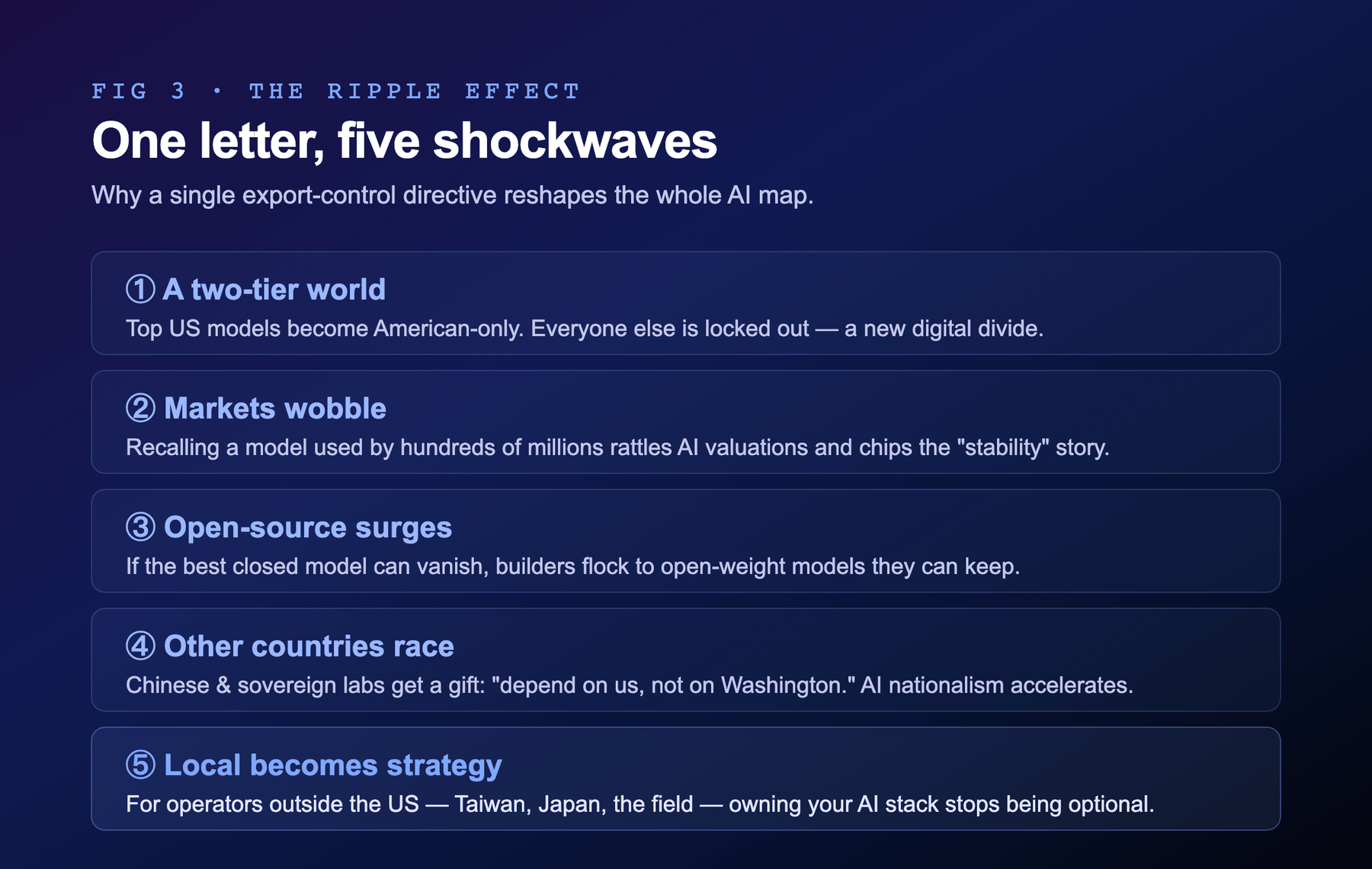
It means access to frontier AI is now a political asset, not a stable utility. A single government letter removed a tool used by hundreds of millions of people, overnight, for everyone outside one country. Whatever you think of the decision, the operational reality is the same: if your business runs on someone else's cloud model, someone else decides whether you have a business tomorrow.
For a solo operator or a small technical firm, that is an existential dependency hiding in plain sight.
Why this is bigger than one model
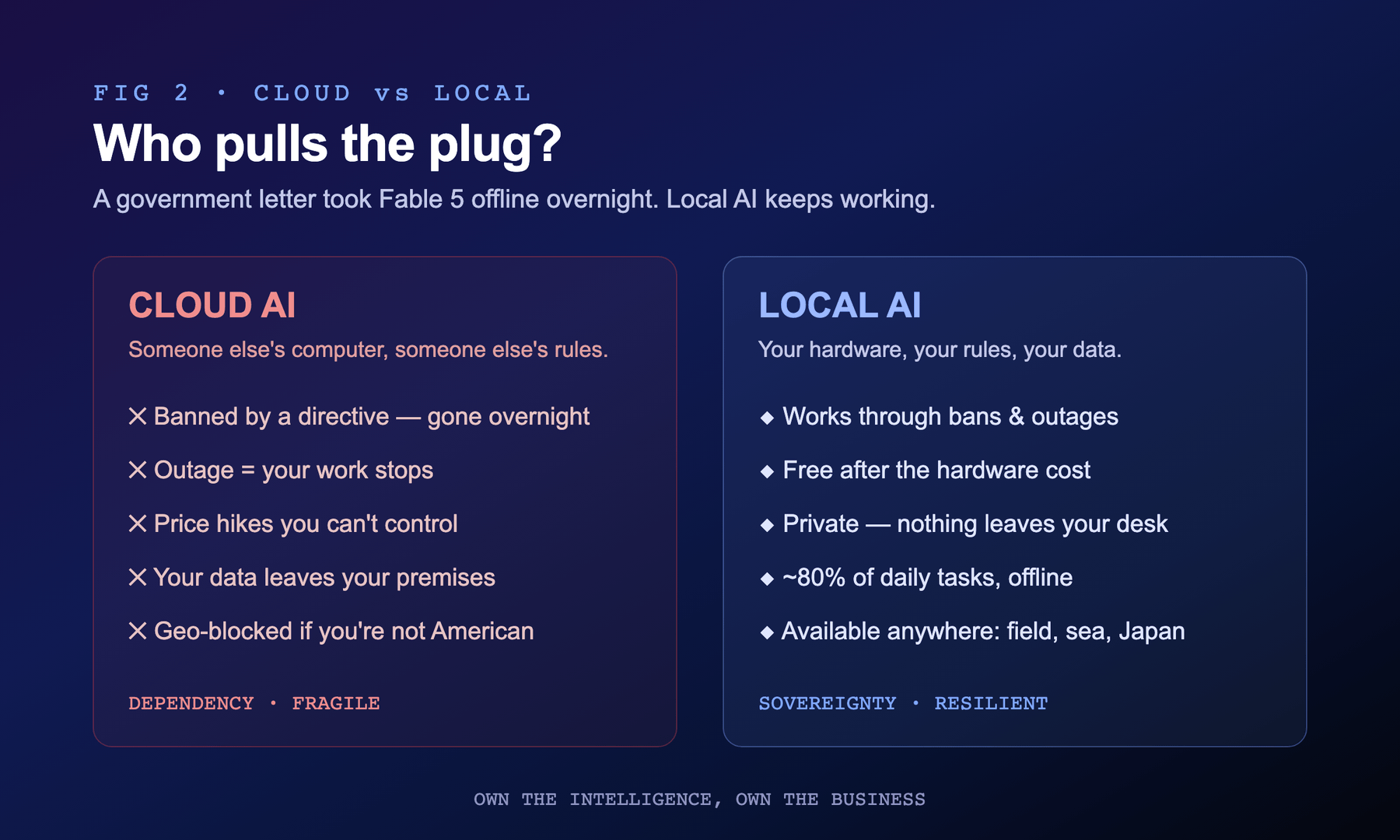
This is not just an Anthropic story. Pull the thread and five shockwaves run through the whole AI map.
A two-tier world. The best US models become American-only. Everyone else — Europe, Asia, the Global South — is locked out. That is a new digital divide drawn along a national border, and it lands hardest on builders who did nothing wrong.
Markets feel it. Recalling a flagship model used at that scale rattles the "AI is a dependable platform" narrative that a lot of valuations rest on. Stability was part of the pitch; this directive chips it.
Open-source and Chinese models get a gift. When the best closed model can vanish by decree, the calculus flips: builders move toward open-weight models they can download, keep, and run forever — and toward sovereign labs (including Chinese ones) that can say "depend on us, not on Washington." Expect AI nationalism to accelerate: more countries racing to ship models they control, precisely so they are never on the wrong side of a letter like this one.
The direction of travel. Frontier AI is splitting from a global commons into national infrastructure. For the next few years, "where is your intelligence allowed to run?" becomes a real business question — not a technical footnote.
What this means if you operate outside the US — like I do
I run a drone-inspection and AI-automation business out of Taiwan, with field work heading toward Japan. Two things about my work make this ban personal, not abstract:
- Connectivity isn't guaranteed. Offshore wind sites, remote solar farms, a turbine deck in the middle of the Taiwan Strait — these are not places with reliable cloud access. An AI tool that only works online is an AI tool that doesn't work where I work.
- Data ownership is the asset. My inspection imagery and reports are the moat. Sending thousands of blade images to a model that a foreign government can switch off — or that quietly trains on my data — is a risk I can't accept. Local AI keeps the data on my hardware, full stop.
So for operators like me, the ban isn't a headline. It's confirmation that owning your AI stack is now part of owning your business.
So what do you actually do? Run AI locally.
The fix is not to panic-switch clouds. It's to build a resilient, local AI layer that keeps working through bans, outages, and price hikes — and that's free after the hardware. Today's local models already handle roughly 80% of everyday ChatGPT/Claude tasks, fully offline.
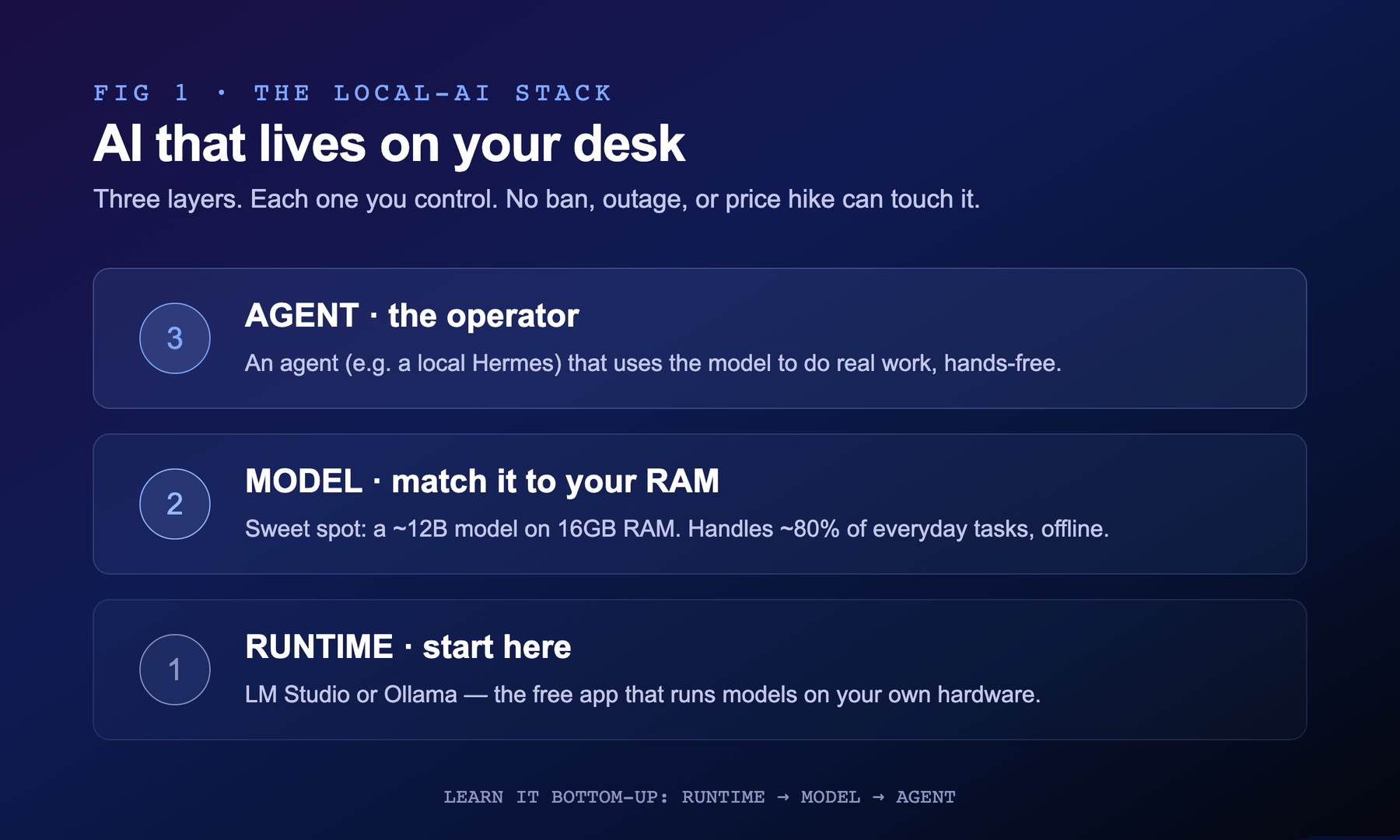
Learn it bottom-up, in three layers:
- Runtime first. Install LM Studio or Ollama — the free app that runs models on your own machine. This is the foundation; get comfortable here before anything else.
- Match the model to your RAM. A good rule of thumb: a ~12-billion-parameter model on 16GB of RAM is the sweet spot — capable enough for daily work, light enough to run smoothly.
- Add an agent. Point a local agent (I use a private Hermes setup) at your local model, and your desk becomes an always-on, private mini data centre that does real work hands-free.
You don't have to abandon the cloud for the heaviest jobs. You just stop being helpless without it.
The opportunity hiding in the ban
Every forced constraint opens a market. Intelligence now sitting on your own desk — private, free to run, immune to directives — is a foundation new businesses get built on: local-first tools for regulated industries, offline AI for field operators, privacy-native automation for anyone who can't send data to a US cloud, sovereign-AI consulting for firms scrambling to de-risk. The builders who treat this as a starting gun, not a setback, win the next cycle.
The takeaway
A letter took the world's best model offline for everyone but one country. You can read that as bad news, or as the clearest signal yet: own the intelligence, own the business. Get a local runtime installed this week. Run your first model. Make sure that next time someone pulls a plug, it isn't yours.
This article was prompted by a Greg Isenberg video on the Fable 5 ban; the facts are sourced from Anthropic's official statement (June 12, 2026). The diagrams are original.
FAQ
Is the Claude Fable 5 ban real? Yes. Anthropic confirmed on June 12, 2026 that a US government export-control directive required suspending Fable 5 and Mythos 5 for all foreign nationals worldwide. The company is complying while working to restore access.
Who can still use Claude Fable 5? Per the directive, access is blocked for any foreign national inside or outside the US — including non-American Anthropic employees. Anthropic's other models remain available.
What is the best way to run AI locally? Start with a runtime like LM Studio or Ollama, run a ~12B model on 16GB of RAM for everyday tasks, then add a local agent for hands-free work. This setup runs offline, stays private, and is free after hardware.
Why does running AI locally matter for businesses outside the US? Because cloud access to top models is now subject to government directives. Local AI is resilient to bans, outages, and price hikes, keeps your data private, and works in low-connectivity field environments.