Quick answer: Wind turbine blade inspection uses three main access methods: drones, rope access and ground-based cameras. Drones cover a turbine fastest and keep people off the blade, rope access allows close contact and minor repairs, and ground-based photography is cheap but weakest on data quality.
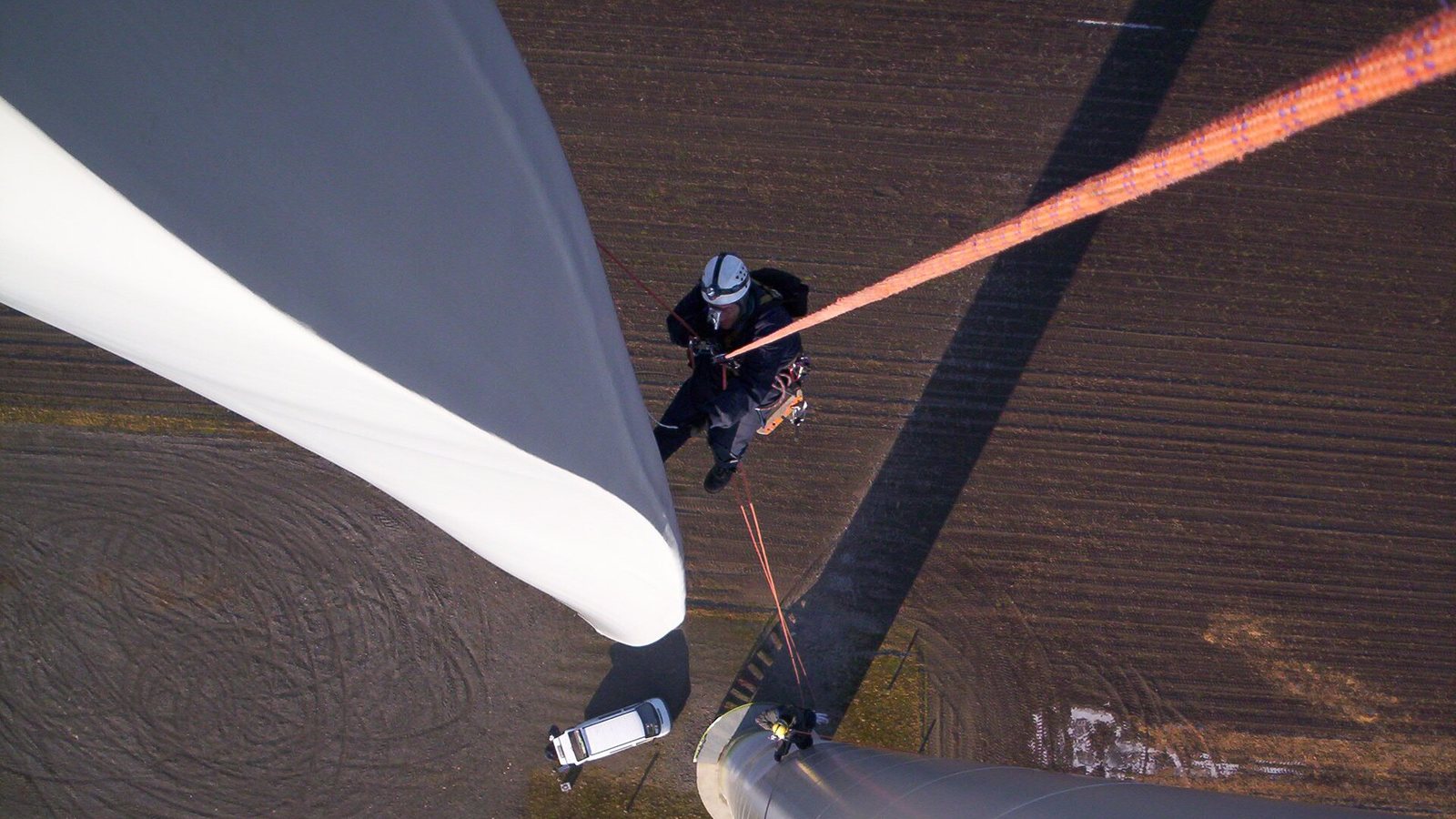
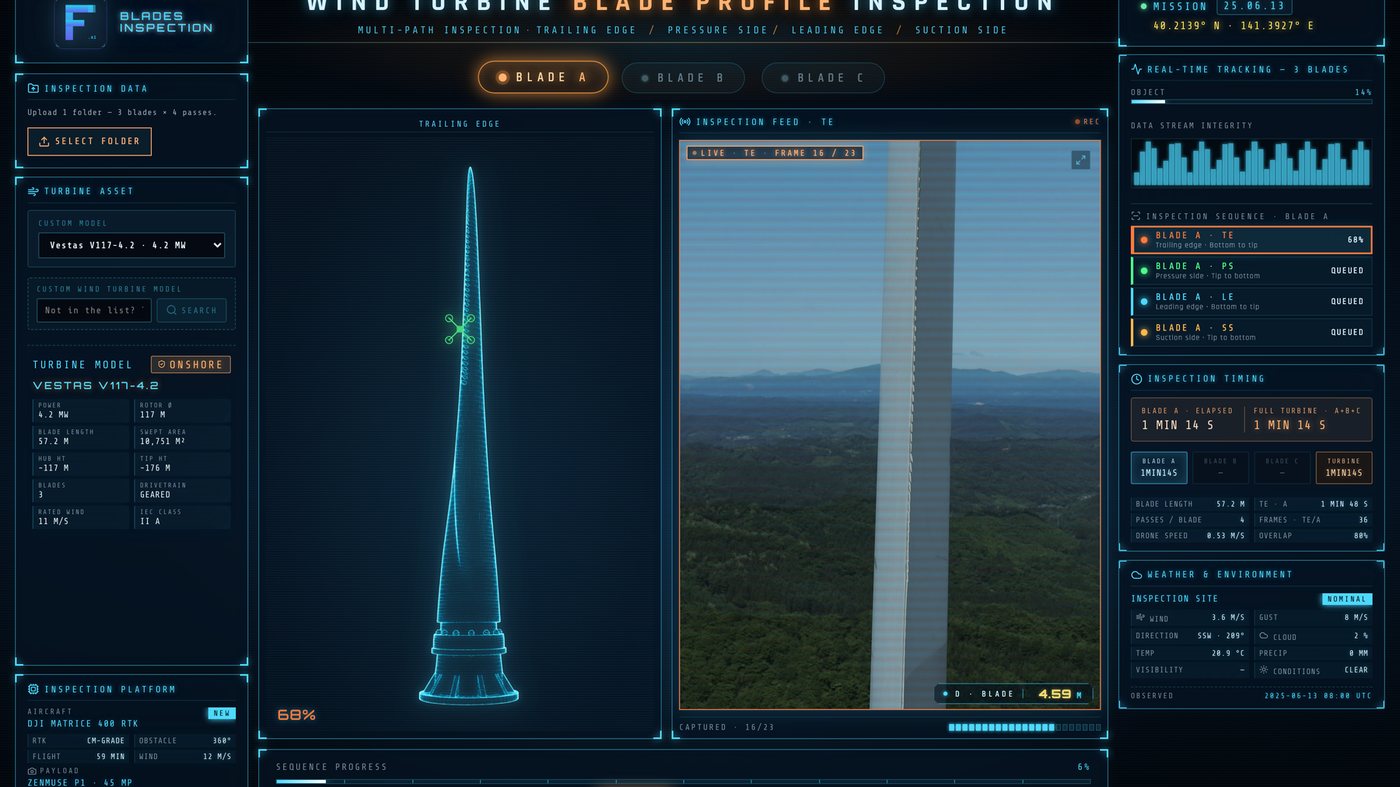
Rehearsing a three-blade, four-pass drone inspection mission in the Turbine Inspection Simulator. Screenshot by FABIEN-STARSEED.COM. Cover photo: Markus Bergmann, CC BY-SA 3.0, via Wikimedia Commons.
The three methods side by side
Factor
Rope access or platform
Ground-based
Drone
Time per turbine
3 to 6 hours
3 to 6 hours
15 minutes to 1 hour
Turbines per day
1 to 2
3 to 4
5 or more
Staff required
Minimum 3
1 person
1 person
Safety
Hazardous (work at height)
Safe
Safe
Data quality
High
Low
High
Figures from a heliguy blog post (a drone vendor), January 2023. They are general vendor estimates, not an independent field benchmark.
What each method is good and bad at
Rope access: allows close-up examination and some minor repairs during inspection. The turbine must be stopped for several hours, work at height raises risk and insurance costs, and human error can leave data unreliable or incomplete. (heliguy)
Ground-based: the photographer stays on the ground, one person is enough, and in low wind the turbine need not be stopped. Data quality is poor in shadowed areas and at the fast-moving blade tips. (heliguy)
Drone: can operate in higher winds than the other methods, depending on the platform's wind resistance, supports repeatable automated flight paths and measurement of damage size, and can carry visual and thermal sensors. (heliguy)
Damage that a visual check cannot see
Sandia National Laboratories, working under the US Department of Energy's Blade Reliability Collaborative, notes that visual inspections only show surface damage, and that a crack visible on the outside is often already severe. It tested drones with infrared thermography, which can reveal flaws up to half an inch deep, and a crawling robot that scans for internal damage with phased array ultrasonic imaging. (Sandia, 2019)
Combining methods: a German offshore rule
As reported, the German Federal Maritime and Hydrographic Agency (BSH) specification allows 50% of turbines per year to be inspected by drone, with 8% of those additionally inspected by rope access after expert review of the drone footage. Deutsche Windtechnik ran a large drone campaign at the Butendiek offshore wind farm (80 Siemens Gamesa SWT 3.6-120 turbines) and says the drone significantly reduced turbine downtime during inspections. That is the company's own statement, not independently verified. (offshoreWIND.biz, 2023)
A Japan example: fully automated drone inspection
On 29 November 2023, Japan's NEDO announced that Toshiba Energy Systems & Solutions had completed the technical evaluation for fully automated drone inspection of 15 MW-class blades, at Shikoku Wind Power's Sozu Wind System in Ehime Prefecture. The drone detects the turbine position, nacelle direction and blade stop position by itself and tracks blades swaying in wind and waves to capture images. NEDO also notes that offshore work needs maintenance staff able to work safely in strong wind and waves, and that reaching turbines requires boats. (NEDO, 2023)
How to choose (a reading of the sources above)
For fast, repeatable screening of whole blades, drones lead on time, staffing and safety.
For close contact or minor repairs on the spot, rope access still has a role.
For a cheap, quick look from the ground, ground-based photography works, but accept its limits in shadows and at the blade tips.
To find damage below the surface, visual imagery is not enough; consider non-destructive methods such as thermography or ultrasonics.
Many sites can combine methods, as the BSH specification does.
Limits of this page
Most figures are vendor or company statements, not independent field comparisons. We did not find a source that directly benchmarks ground-based telescopes or long-lens cameras against the other methods, and we did not obtain Taiwan-specific comparison data. Treat every number as indicative.
Fabien's service
Fabien specializes in drone-based blade inspection for onshore and offshore wind farms in Taiwan and has inspected about 3,000 turbines by drone.
Is drone blade inspection faster than rope access?無人機檢查比繩索作業快嗎?ドローン点検はロープアクセスより速いですか?
heliguy, a drone vendor, estimates 15 minutes to 1 hour per turbine for a drone versus 3 to 6 hours for rope access, and Deutsche Windtechnik says drones cut turbine downtime. These are vendor or company statements, not independent field measurements.依 heliguy(無人機廠商)的估計,無人機每座風機約 15 分鐘至 1 小時,繩索作業約 3 至 6 小時。Deutsche Windtechnik 也表示無人機縮短了停機時間。這些是廠商或公司的說法,不是獨立實測。ドローン事業者のheliguyは、1基あたりドローンは15分〜1時間、ロープアクセスは3〜6時間と見積もっています。Deutsche Windtechnikもドローンで停止時間が短縮されたと述べています。いずれも事業者・企業の説明であり、独立した実測ではありません。
Can drones fully replace rope access?無人機可以完全取代繩索作業嗎?ドローンでロープアクセスを完全に置き換えられますか?
Not always. As reported, the German BSH specification allows 50% of turbines per year to be inspected by drone, with 8% of those also inspected by rope access after expert review. Rope access also allows close contact and minor repairs.不一定。據報導,德國 BSH 規範允許每年以無人機檢查 50% 的風機,其中 8% 在專家檢視影像後仍另外以繩索作業檢查。繩索作業也能近距離接觸並做小型修補。必ずしもそうではありません。報道によると、ドイツのBSH仕様では毎年50%の風車をドローンで点検でき、そのうち8%は専門家の確認後にロープアクセスでも点検します。ロープアクセスは近接確認や軽微な補修もできます。
What is ground-based blade inspection?什麼是地面式葉片檢測?地上からのブレード点検とは何ですか?
A photographer stays on the ground and photographs the blades. One person is enough and the turbine need not be stopped in low wind, but data quality is poor in shadowed areas and at the fast-moving blade tips.攝影者留在地面拍攝葉片,只需 1 人,風小時風機不必停機,但陰影區與高速移動的葉尖資料品質較差。撮影者が地上からブレードを撮影する方法です。1人で対応でき、風が弱ければ風車を止める必要がありませんが、影の部分や高速で動くブレード先端ではデータ品質が低くなります。
Can visual images find damage inside a blade?目視影像能發現葉片內部損傷嗎?目視画像でブレード内部の損傷は見つかりますか?
No. Sandia National Laboratories notes that visual inspections only show surface damage. It tested drone-mounted infrared thermography and a phased array ultrasonic crawling robot to find damage below the surface.不能。桑迪亞國家實驗室指出目視檢查只看得到表面損傷。該實驗室測試了無人機紅外線熱成像與相位陣列超音波爬行機器人,用於找出表面以下的損傷。いいえ。サンディア国立研究所は、目視点検では表面の損傷しか見えないと指摘しています。同研究所は、表面下の損傷を見つけるため、ドローン搭載の赤外線サーモグラフィとフェーズドアレイ超音波のクローラーロボットを試験しました。
Can drones inspect large blades automatically?無人機能自動檢查離岸風機葉片嗎?ドローンで大型ブレードを自動点検できますか?
In November 2023, Japan's NEDO announced that Toshiba Energy Systems & Solutions had completed the technical evaluation for fully automated drone inspection of 15 MW-class blades. The drone detects turbine position, nacelle direction and blade stop position by itself and tracks swaying blades to capture images.日本 NEDO 於 2023 年 11 月發表,東芝能源系統完成 15 MW 級葉片無人機全自動檢查的技術評估,無人機可自行偵測風機位置、機艙方向與葉片停止位置,並追蹤搖晃的葉片拍攝。2023年11月、NEDOは、東芝エネルギーシステムズが15MW級ブレードのドローンによる完全自動点検に必要な技術評価を完了したと発表しました。ドローンは風車の位置、ナセルの向き、ブレードの停止位置を自ら検出し、揺れるブレードに追従して撮影します。
Does Fabien offer drone blade inspection in Taiwan?Fabien 提供台灣的無人機葉片巡檢嗎?Fabienは台湾でドローンによるブレード点検を行っていますか?
Yes. Fabien specializes in drone-based wind turbine blade inspection for onshore and offshore wind farms in Taiwan, and builds software around it: weather go/no-go verdicts, a 3D turbine viewer and photo tools.是的。Fabien 專注於台灣陸域及離岸風場的無人機風機葉片巡檢,並打造飛行天氣判斷、3D 風機檢視器與照片工具等軟體。はい。Fabienは台湾の陸上・洋上風力発電所向けにドローンによる風車ブレード点検を専門とし、気象のGo/No-Go判定、3Dタービンビューア、写真ツールなどのソフトウェアも開発しています。
FREE · 60 MIN · NO PITCH免費 · 60 分鐘 · 不推銷無料 · 60分 · 売り込みなし
Book your free 1-hour call預約你的免費 1 小時諮詢無料1時間相談を予約する
Tell me a little about you and I'll email you back to lock in a time, usually within a day.留下你的資訊,我會回信與你敲定時間,通常一天內回覆。あなたのことを少し教えてください。日時を確定するためにメールでご返信します。通常1日以内です。
Thanks, your request is on its way to Fabien. You'll get an email shortly to confirm a time.謝謝,你的預約已送出給 Fabien。你很快會收到確認時間的電子郵件。ありがとうございます。リクエストはFabienへ送られました。まもなく日時確認のメールが届きます。